Kerala, which declared the internet as a citizen's right for the first time in India, has achieved unprecedented growth in the digital space and become the fully e-governance state in the country. The aim of the comprehensive e-governance system is to make government services available to all sections of society in a transparent and speedy manner using modern technology and digital platforms.
Various departments of the Government of Kerala are providing a number of service schemes to people from all walks of life with the help of information technology. Recognizing that it is imperative that all services are made available through a unified portal while sitting at their homes without having to go to government offices, a centralized service portal called e-Service has been formed by connecting the services of various departments in a single portal to make government services available to citizens in a speedy and timely manner. 885 services are made available through the e-Service Portal (services.kerala.gov.in).
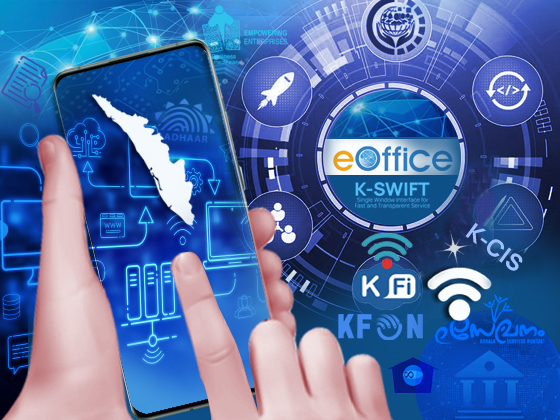
The delivery of all vital services covering all major domains, including health, education, land taxes, documentation of the property, the public distribution system and social security payouts, has already been digitized. The state has also successfully implemented large-scale projects such as e-District, K-SWIFT, eHealth, EPDS, e-Court Management, ERSS, Pol App, CyberDome, KITE, HSCAP and Digital Survey Mission.
The state has taken steps to make the service of doctors available from anywhere through the e-health system. Kerala has also implemented one health record per citizen at a rapid pace. The benefits of e-Governance have been made available to all sections of the people in all sectors of the state. The public distribution system has come under the complete control of e-governance. Through this, it was ensured that the rationing system is properly and systematically distributed to the public. The entire land was measured and counted through a digital survey and a Thandaper scheme was implemented for a citizen. Documents including title deeds were made available online.
Launched in 2002 with the aim of opening the door to digital literacy for at least one member of a family, the Akshaya Scheme has now become a digital hub for various schemes and welfare activities of the state government. Launched with the aim of making more than 4 lakh students computer literate through schools every year, IT@School initiative has further strengthened public education. The unique dashboard, which provides first-level statistics of all online application services provided by government departments and agencies, were all major steps in Kerala towards a full-fledged e-governance state.
As the innovation and adoption of technology gained momentum, the gap between those who had access to the Internet and those who did not widened. In this context, the government understood the need for the Internet for all citizens in a digital society and declared the "Internet as a fundamental right". KFON is a government scheme aimed at avoiding the digital divide. The KFON network is designed to connect 30,000 government institutions in Kerala and more than 20 lakh BPL families.
E-Office, a digital file flow system, has been successfully implemented to make government offices paperless, which has increased efficiency and transparency in file movements. More than 150 offices are now e-offices. The implementation of e-office at taluk and village levels is being done in the best possible manner. The e-office is a digital file flow system that includes the state secretariat, all major government departments, all collectorates, 25 revenue divisional offices, directorates and commissionerates.
The government aims to make Kerala a 100 per cent e-literal, digital state and develop and market it as the country's most preferred IT/ITES investment destination. The digital resurvey of the revenue department, pravasi mitram, the citizen centre portal of the local self-government department, the Ksheerashree portal of the animal husbandry department, Chief Minister's grievance redressal portal,website of Public Service Commission etc. are some of the examples of the digital services implemented by various departments.
As a tool for the overall development of the state, as a critical component of economic growth and as a scientific driver for enhancing productivity, speed and transparency and improving the quality of life of the common man, Kerala has formulated and implemented comprehensive mechanisms and schemes for digital diffusion.
Last updated on : 2026-05-18 12:24:11
Article No: 1066